

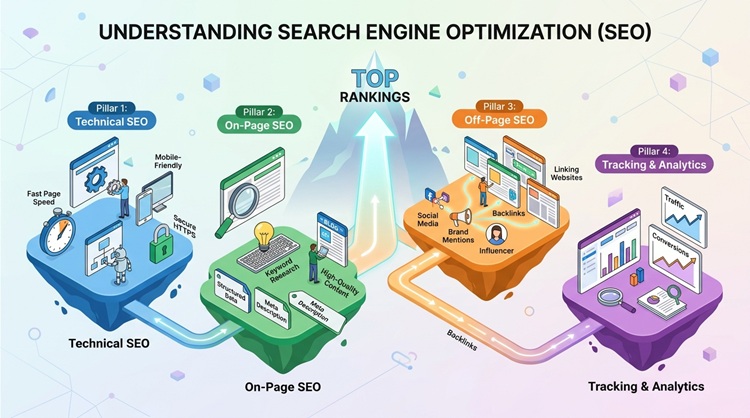
Because being on Google’s top page is often seen as the pinnacle of online success, many companies make significant investments in SEO. Increased exposure, website traffic, and brand recognition are all possible with high rankings. High rankings, however, do not always equate to more revenue, devoted clients, or sustained expansion. As businesses recognize that traffic alone cannot sustain a firm, the discussion of SEO vs. revenue: why rankings don’t necessarily lead to growth has grown in significance.
Even with thousands of monthly visits, a website may not be able to produce leads or revenues. The disparity between digital exposure and real company success is highlighted by this mismatch.
Table of Contents
Customer Intent Is Not Guaranteed By Rankings
The fact that not every visitor has the intention of making a purchase is one of the main reasons search engine success may not translate into company success. A business may score strongly for general informative keywords that draw in inquisitive readers rather than prospective clients.
For instance, a company that sells exercise equipment can get a lot of traffic from people looking for workout advice rather than from people who are prepared to buy equipment. Despite an increase in website visitors, conversions are still poor since the target population does not share the company’s objectives.
Companies that just concentrate on rankings sometimes fail to see the significance of focusing on people who are actively looking for goods or services.
The Value Of Traffic Without Conversion Is Limited
Only when website traffic results in worthwhile activities is it considered beneficial. There is little commercial gain when a visitor leaves the website in a matter of seconds without interacting.
While neglecting conversion rates, many businesses laud gains in keyword ranks. This gives the impression of progress. Rankings by themselves cannot sustain growth if web visitors are not completing contact forms, making purchases, scheduling consultations, or subscribing to services.
Instead of concentrating just on visibility before the click, a good digital strategy should include user behavior after the click.
Results Are Reduced By A Bad Website Experience
A bad user experience might hinder a business’s performance even if search engines direct users to a website. Potential clients are often deterred from acting by slow loading times, complicated navigation, antiquated design, and ambiguous messages.
A well-ranked website that irritates visitors may have poor conversion rates and high bounce rates. Search visibility draws interest, but whether or not that attention turns into cash depends on the user experience on the page.
Businesses that invest in both customer experience and SEO often see better long-term outcomes.
More Factors Affect Revenue Than Just Visibility
Search rankings are not the only element that affects business success. Profitability is influenced by a number of factors, including pricing, customer service, product quality, brand trust, and market competitiveness.
Even while a business outperforms rivals online, bad customer service or low-quality products may lead it to lose clients. In a similar vein, a smaller business with lower rankings may do better than its bigger rivals thanks to improved customer satisfaction and deeper connections.
This is why discussions about seo vs revenue: why rankings don’t always lead to growth continue to gain attention among business owners and marketers.
False Confidence Can Be Caused By Vanity Metrics
Because these figures seem good in reports, some companies place a lot of emphasis on vanity metrics like impressions, clicks, or keyword positions. These metrics, however, don’t always accurately represent the real business effect.
While income stays the same, a business may see an increase in traffic. Sometimes companies spend a lot of money on marketing while pursuing rankings without considering how those rankings affect their bottom line.
Instead of focusing just on search exposure, measures like customer acquisition, retention, revenue growth, and return on investment should be used to gauge true company progress.
Audience Quality Is More Important Than Quantity
Not every guest has the same worth. Compared to large traffic with little interest in making purchases, a smaller audience with high purchase intent may provide superior business outcomes.
Campaigns created solely for traffic volume are frequently outperformed by targeted SEO tactics that concentrate on qualified leads. Attracting the correct audience is more beneficial to businesses than just increasing traffic.
In Conclusion
Although search engine exposure is still a crucial component of digital marketing, rankings by themselves do not ensure that a firm will succeed. Businesses that just concentrate on traffic often ignore the more fundamental elements that drive development and profitability.
The discussion surrounding seo vs revenue: why rankings don’t always lead to growth reminds businesses to prioritize meaningful outcomes instead of vanity metrics. Converting visibility into trust, engagement, customer loyalty, and long-term income is the key to true success.